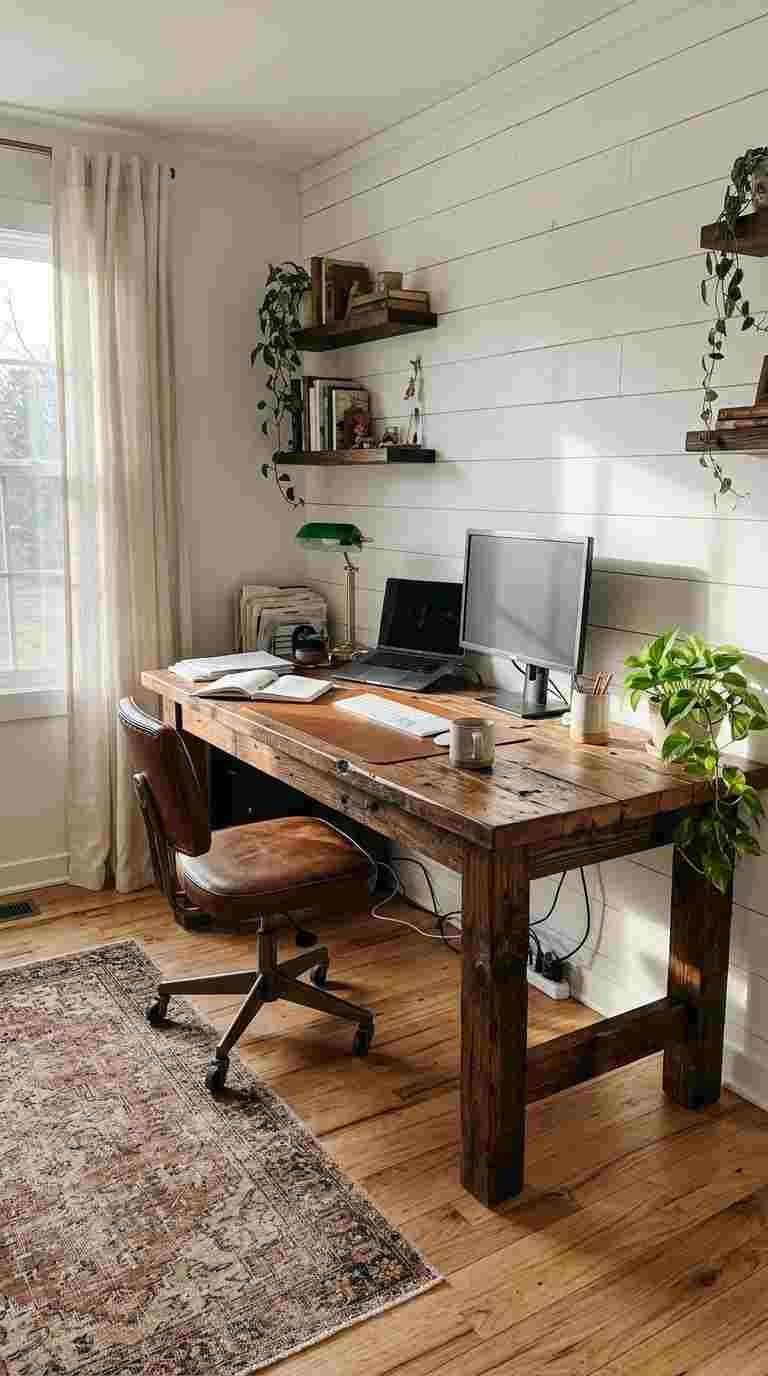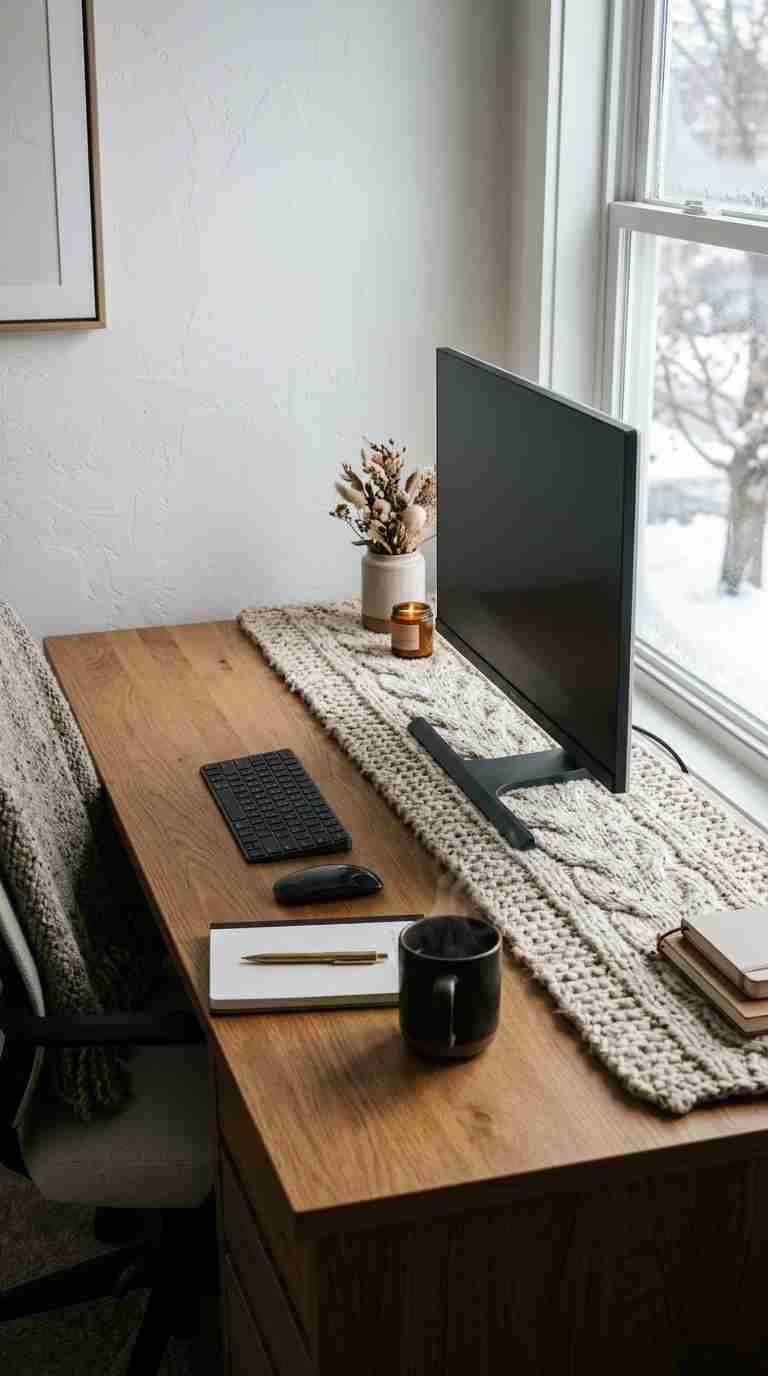

18 Modern Winter Home Office Decor Ideas 2026 for a Sleek and Stylish Seasonal Look
Winter light is low, cool, and brief, so a modern home office needs to work harder in the colder months. The ideas below use clean lines, glass, metal, and monochrome palettes to keep a workspace sleek instead of cluttered, while still feeling calm on dark mornings. Each idea focuses on one clear change, from the desk and chair to lighting, storage, and the wall behind the screen, so you can apply it in a small corner or a full room. For a softer take on the same season, see these minimalist winter home office ideas. Use the measurements and placement steps in each section to plan first, then keep only the pieces that earn their space.
Frame Your Desk with Floor-to-Ceiling Black-Framed Windows

Start with the view, because in winter the window is the room’s largest light source. Black-framed, floor-to-ceiling glazing turns a snowy garden or forest into a framed picture, and the dark frames add the graphic contrast that defines modern design. Place the desk perpendicular to the glass, about 60 to 90 centimetres from the wall, so the screen faces the room and daylight falls across the desk from the side instead of glaring into the monitor. Keep the sill clear, choose a slim desk with a depth of 60 centimetres, and leave at least 90 centimetres of walking space behind the chair. The approach follows the same principles as modern architecture, where structure, glass, and open space do the decorating. Add a single low plant or a plain white vase on the desk, and let the snow outside supply the colour.
Build a Sleek Dual-Screen Desk Setup in Black and Silver

A second screen makes winter work faster, but it only looks modern when the setup stays strict. Choose a monitor between 24 and 27 inches, mount it on a slim silver arm, and set its top edge level with your eyes when you sit upright, about 50 to 70 centimetres from your face. Place the laptop on a matching silver stand at the same height, so both screens sit in one clean line instead of stepping up and down. Keep the keyboard and mouse in black, use one short cable for each device, and run the cables through a single tray fixed under the desk so nothing hangs against the wall. Leave 40 centimetres of clear desk in front of the keyboard for notes and a notebook. The contrast with a cozy winter home office is clear: here, the silver metal and black screens are the decoration, and every extra object is removed.
Use Crisp White Horizontal Blinds to Control Low Winter Sun

Winter sun sits low and can shine straight across a screen for hours, so the right blind matters more than any lamp in December and January. White horizontal blinds with slats 50 millimetres wide give you exact control: tilt them up by 45 degrees to bounce daylight onto the ceiling, or close them fully when the sun drops to eye level. Measure the window recess first, then order the blind 5 millimetres narrower than the recess so it fits without rubbing the frame, and mount the headrail at the top of the recess for a flush, built-in look. Choose a cordless design with a slim white wand, which keeps the window wall flat and removes dangling cords from view. Keep the sill empty except for a single white notebook or a slim desk lamp, and let the repeated horizontal lines of the slats echo the clean geometry of the desk below.
Choose a Glass-Top Desk with Slim Wooden Legs

A glass top makes a small winter office feel larger because light passes through it instead of stopping at a solid surface. Look for tempered glass at least 8 millimetres thick, on slim wooden legs in pale oak or walnut, with a top measuring about 120 by 60 centimetres for a laptop and a notebook. Wipe the surface each morning with a damp microfibre cloth, since fingerprints show more on glass in low winter light, and keep a leather or cork desk mat under the keyboard to stop items sliding. Place the desk 10 centimetres from the wall so cables can drop behind it, and choose a chair with a slim back so the glass stays visible from the door. Under the desk, leave the floor clear: a glass top works best when the space beneath it stays open, which also makes the room easier to clean during the winter months.
Build an All-White Desk Zone with Open Cubby Shelving

An all-white zone bounces the little daylight winter offers, so the room reads brighter without adding lamps. Paint the wall behind the desk in a flat matte white, choose a white desk with a depth of 60 centimetres, and add open cubby shelving above it in the same white finish, with each cubby about 30 centimetres square. Fill no more than two-thirds of the cubbies: leave empty space between white boxes, a stack of notebooks, and one small plant, so the shelving stays a display rather than a store cupboard. Add one black or charcoal accent, such as a desk lamp or a chair frame, to stop the white from looking flat. Keep the chair, the keyboard, and the monitor in white or silver, wipe the surfaces weekly, and let the single dark accent carry all of the contrast in the room.
Lay a Black Leather Desk Mat Over a White Desk

A black desk mat is the fastest way to give a white desk a modern focal point, and it costs less effort than replacing the desk itself. Choose a leather mat about 80 by 40 centimetres, large enough for a keyboard and a mouse with room to spare, and lay it with 5 centimetres of white desk showing on each side so the black reads as a deliberate layer. The smooth surface protects the desk from scratches and coffee rings, and it gives your wrists a warmer surface than bare laminate on cold mornings. Pair it with a black wireless keyboard, a silver laptop stand, and a single black pen holder, keeping everything else on the desk white or clear glass. If the mat curls at the corners, place books on it overnight to flatten it, and wipe it with a dry cloth once a week to keep the black deep and even.
Choose a Sculptural Gray Leather Chair on a Chrome Base

The chair is the largest object in most home offices, so it sets the style of the whole room. A sculptural gray leather chair on a polished chrome base reads as furniture, not equipment, and the soft gray works with the cold light of a winter window. Set the seat height so your feet rest flat on the floor with your knees at about 90 degrees, usually 45 to 50 centimetres from the floor, and set the armrests level with the desk top, about 72 centimetres high. Leave 60 centimetres of clear space behind the chair so it can swivel without hitting the wall, and keep the desk edge free of bags and boxes so the chrome base stays visible. Choose smooth leather in a mid-gray, not black, so dust and pet hair show less, and condition the leather every few months following the maker’s instructions to keep it supple through the dry winter air.
Add a Black Arc Floor Lamp to Light the Desk from Above

Overhead light from a tall arc lamp fills a winter office without taking up desk space, and the curve itself becomes a piece of sculpture. Place the heavy base 30 to 40 centimetres behind the desk corner, then swing the arc so the shade hangs 60 to 70 centimetres above the desk surface and slightly in front of the chair, where it lights your work instead of your screen. Choose a matte black finish with a white inner shade, which reflects light downward and keeps the glare out of your eyes, and fit a warm-white bulb of about 2700 to 3000 kelvin so the light feels like late afternoon rather than an office ceiling. Keep the cord flat against the wall with a cable clip, and leave the floor under the arc clear so the lamp’s silhouette stays clean. For more ways to layer light in winter, see these winter home office lighting ideas.
Set a Narrow Desk Right Against the Window for Winter Daylight

Daylight is scarce in winter, so do not waste a window on a storage unit or a plant stand. Push a narrow desk, about 100 to 120 centimetres wide and 45 to 50 centimetres deep, right up to the glass, and sit facing the view with your laptop between you and the window. A laptop screen angled slightly downward avoids the worst reflections, and a matte screen filter helps on bright snowy days when the light bounces off the ground. Keep the desk surface almost empty: a laptop, a notebook, and a glass of water are enough, because every extra object blocks light and breaks the view. Add a slim glass carafe and a small hourglass or a desk clock on one corner, and use the windowsill for nothing at all. When the sun sets early, the same position puts your desk lamp exactly where you need it.
Hang a Round Black-Framed Mirror Above a Slim Desk

A round mirror softens all the straight lines of a modern desk, and it doubles the daylight in a room that gets only a few hours of sun. Hang a mirror 60 to 80 centimetres across, in a slim black frame, centred above the desk with its bottom edge 20 to 25 centimetres above the desk surface, so it reflects the window opposite rather than the ceiling. Fix it to a wall stud or use a wall anchor rated for at least twice the mirror’s weight, and check with a spirit level that the frame sits perfectly straight, because a tilted circle is easy to spot. Keep the desk below it simple: a laptop, a notebook, and a small gray chair, with a single black pendant light hanging beside it. The mirror works best when the wall around it stays bare, following the minimalism idea that one strong object beats a wall of small ones.
Switch to a Height-Adjustable Desk with a Slim White Top

Sitting all day is harder in winter, when cold muscles stiffen faster, so a desk that changes height is a practical modern choice. A height-adjustable desk with a slim white top, about 120 by 60 centimetres and 25 millimetres thick, lets you work seated at 72 centimetres and standing at 105 to 115 centimetres, depending on your height. Set the standing height so your elbows bend at 90 degrees with the keyboard in front of you, and stand for 20 to 30 minutes at a time before sitting again. Keep the top almost bare, with a monitor on a slim arm and a single notebook, so the lifting mechanism moves freely and the cables do not snag. Run the power cable through a clip on the desk leg, leave 80 centimetres of clear floor behind the desk for standing, and choose a white top that matches the wall so the mechanism, not the desk, stays out of sight.
Go Monochrome: Black Desk, White Keyboard, Silver Accents

Monochrome is the simplest modern palette, and it is the easiest to keep consistent through winter, when daylight changes the colour of everything else. Start with a matte black desk about 120 by 60 centimetres, add a white wireless keyboard and a white mouse, and finish with silver accents: a laptop in silver, a chrome desk lamp, and a silver pen cup. Keep the wall white, the chair gray or black, and the floor pale, so the black desk is the darkest object in the room and everything else steps back from it. Place the keyboard 10 centimetres from the desk edge, centre the mouse to its right, and keep a single white notebook on the left for balance. Dust the black surface with a dry microfibre cloth each evening, because dust shows quickly on black in low light, and avoid patterned objects entirely, since even one print breaks the monochrome effect.
Divide the Room with Frosted-Glass Panels in Black Frames

Open-plan rooms lose their focus in winter, when everyone gathers near the heat, so a frosted-glass divider gives the office a boundary without blocking light. Choose panels about 180 centimetres tall and 60 to 90 centimetres wide, in frosted glass set in slim black metal frames, and stand them on adjustable feet so they sit level on an uneven floor. Place two or three panels in a straight line or a shallow L shape, leaving a gap of 80 centimetres for a doorway and at least 90 centimetres behind the chair for movement. The frosted surface hides the rest of the room while letting daylight through, which keeps the office bright even in January. Wipe the glass with a damp cloth once a week, keep the black frames free of dust, and leave the top 10 centimetres of each panel clear so the divider reads as a screen, not a wall.
Style a Black Metal Shelf with White Ceramic Vases

A freestanding black metal shelf gives you display space without drilling into the wall, and white ceramic vases keep the look bright against the dark frame. Choose a shelf about 80 centimetres wide and 180 centimetres tall, with four or five levels spaced 35 to 40 centimetres apart, and place it against a plain white wall beside the desk, not behind it, so it does not compete with the screen. Style each level with one or two objects only: a tall white vase on one shelf, a stack of two white boxes on another, and a single white ceramic bowl on a third, leaving at least one shelf partly empty. Use vases in different heights, from 15 to 30 centimetres, but keep them all in the same matte white finish so the group reads as one set. Anchor the shelf to the wall with the strap supplied, and dust the black metal weekly so it stays deep and even.
Add a Matte Gray Dome Desk Lamp in Brushed Metal

A dome lamp gives focused task light without the adjustable arms and joints that make some desk lamps look like workshop tools. Choose a matte gray dome about 20 centimetres across, in brushed metal, on a slim stem about 40 centimetres tall, and place it on the left side of the desk if you are right-handed, so your hand never casts a shadow on the page. Fit a warm-white bulb of about 2700 kelvin, and angle the dome down at 45 degrees so the pool of light covers the keyboard and a notebook, not the whole desk. Keep the base 15 centimetres from the desk edge, run its cord straight back to the wall, and pair the lamp with a silver laptop stand and a black pen holder so the three metals, gray, silver, and black, form one quiet group. In the early winter evenings, this single lamp can carry the whole room.
Add One Sculptural Snake Plant in a Sleek White Pot

Most winter plants droop in dry heated air, but a snake plant stands upright with almost no care, and its sword-shaped leaves add a vertical line that suits a modern room. Choose one plant 40 to 60 centimetres tall, in a sleek white cylindrical pot about 15 centimetres across, and place it on the floor beside the desk or on the corner of a wide desk, never in the middle of your work area. Water it only when the top 5 centimetres of soil feel dry, usually every two to three weeks in winter, and keep it 30 centimetres from a radiator so the leaves do not dry at the tips. The green and white contrast works with the pale palette of a neutral winter home office, and one plant is enough: a second pot would turn a sculptural accent into a collection. Wipe the leaves with a damp cloth once a month to keep them glossy.
Place a High-Gloss White Drawer Unit Beside the Desk

A high-gloss drawer unit hides everything a modern desk should not show, from chargers and cables to spare notebooks and printer paper. Choose a unit about 40 centimetres wide, 60 centimetres deep, and 60 centimetres tall, with five drawers on smooth runners, and place it beside the desk on the side away from the window so it does not block daylight. Keep the top clear except for one object, such as a small plant in a white pot or a slim flip clock, and store the rest inside the drawers, with cables in the top drawer, paper in the middle, and spare supplies at the bottom. The glossy white finish reflects light and matches the desk, while the handle-free fronts keep the lines flat and clean. Wipe the surface with a damp cloth each week, and empty the top drawer monthly so it does not become a second junk drawer.
Hang a Matching Trio of Black-Framed Monochrome Prints

Matching frames are what make a group of prints look modern instead of collected over time. Hang three identical black frames, each about 30 by 40 centimetres, in a straight horizontal row with gaps of 5 centimetres between them, centred above a desk or a low cabinet. Use monochrome prints in the same style, such as palm leaves or geometric shapes in black and white, and keep the glass plain and unframed inside the black border. Hang the row so the centre of the frames sits at eye level when you are seated, about 140 to 150 centimetres from the floor, and check the top edges with a spirit level before fixing the last frame. Leave the wall around the trio empty, and keep the desk below it in black, white, and silver so the prints set the palette for the whole corner.
A modern winter home office does not need many things, only the right ones. Pick one idea from this list to start, measure the space first, and keep the palette to black, white, gray, glass, and chrome so each new piece fits the ones you already have. The result is a workspace that stays sleek through the darkest weeks of the year and still works well when the days grow longer again.